This article was originally published in the September issue of Hazardex – The Journal for Hazardous Environments.
The process industry has been blessed with an abundance of software and technology solutions that have transformed the way assets are managed and maintained, using data to enable predictive maintenance and other operational benefits. For the most part, these solutions have been very successful across a number of high hazard process industries.
However, industry requires people to operate and maintain these assets, no matter how reliable or automated the assets are. People are needed to perform frequent procedures and tasks on the assets to help ensure effective and efficient production. Industry is facing several challenges though, such as attracting and retaining skilled workers, dealing with the loss of specific equipment and procedure knowledge from retiring experts or the need to quickly and efficiently replace outgoing knowledge and expertise by upskilling workers.
Digital Twins are already playing a part in this successful asset-intensive focus, yet most chemical and refining companies are failing to utilize digital twins for building workforce competency more efficiently and effectively. Digital Twins of the Person (DToP) offer the ability to have a more inclusive solution, which allows you to build and measure workforce competency in standard operating procedures. We will take a look at a DToP based on Enhanced Reality (ER) technology, which has been successfully adopted in the industry by some of the biggest chemical and refining companies in the world to solve the workforce challenges mentioned before.
This article is based on case study examples that show how DToP and ER technology have helped to speed up the time to operator competency, cut the number of resources needed to train operators, retain specific equipment and procedure knowledge, and reduce incidents related to human-asset interaction.
As part of the plant-specific implementation process of a Digital Twin, all ambiguities are removed from the standard operating procedure. This leads to greatly enhanced procedure clarity – the degree to which the steps within a process are easily understood and unambiguous – and further reduces an important source of operational errors in the field.
This article will also argue that a more inclusive form of Digital Twin can help solve the major workforce challenges in process industries. We will show (anonymous) data from major chemical and refining companies that collected data on ER digital twin simulation versus traditional training methods (time and resources), incident data related to specific procedures/equipment over time, increasing the procedure clarity and upgrading operator knowledge/procedure competency.
The Initial Situation
The process industry is experiencing an increasing scarcity of qualified personnel at an operator level. Reasons for this include:
- Demographics, mass retirements (“the great crew change”)
- Increasing willingness and tendency to switch jobs (“the great resignation”)
- The number of young people undergoing formal education relevant for operating chemical plants does not cover the demand
- More lateral entrants to jobs in chemical operations with less relevant background
In the past, the common practice for training new operators in plant-specific competencies was not overly focused – and it did not need to be. From time to time, when a new operator was incorporated into a shift, there was enough time to acquaint oneself with the job mostly by shadowing experienced colleagues over an extended period and studying the Standard Operating Procedures (SOPs). And there were enough experienced colleagues acting as role models and helping with questions.
Today, the rate at which new hires have to get productive on the job has increased dramatically, while many experienced operators have already left. At the same time, an increasing number of lateral entrants have less manufacturing experience than in the past and need more support for getting onboarded properly. The industry has tried to prepare for this situation by professionalizing plant-specific training over the last couple of decades. However, there is still plenty of room for improvement.
The requirements for a modern, functional operational training system are determined not only by the situation described above but also by the change in learning style in the younger generation. Books are out. Knowledge has to be available for immediate (on-demand) consumption (Google). Visual tutorials for virtually any task are largely available and even though I don’t consider myself part of the ‘young generation’, I have to admit that looking up a YouTube video on how to fix some trouble with my bike always comes in handy.
So, what can we do to deal with this situation more effectively?
Enhanced Reality (ER) is Part of the Solution
When looking for more effective ways of training new operators on plant-specific knowledge, there is consensus that visualization techniques have huge potential. To take it a step further, visualization should be interactive, i.e. paired with simulation, as this will allow the learner to acquire knowledge by doing the tasks virtually by themselves. Learning by doing is key to knowledge retention.
Current attempts to achieve this involve Virtual Reality (VR) technology, which often comes with specialized equipment like VR glasses. This hardware often lacks the robustness that is appreciated in a production environment. Implementation, mostly relying on CAD models or having to create a CAD-model environment from scratch, is expensive and, when it comes to keeping the model up-to-date, it becomes a cumbersome endeavor.
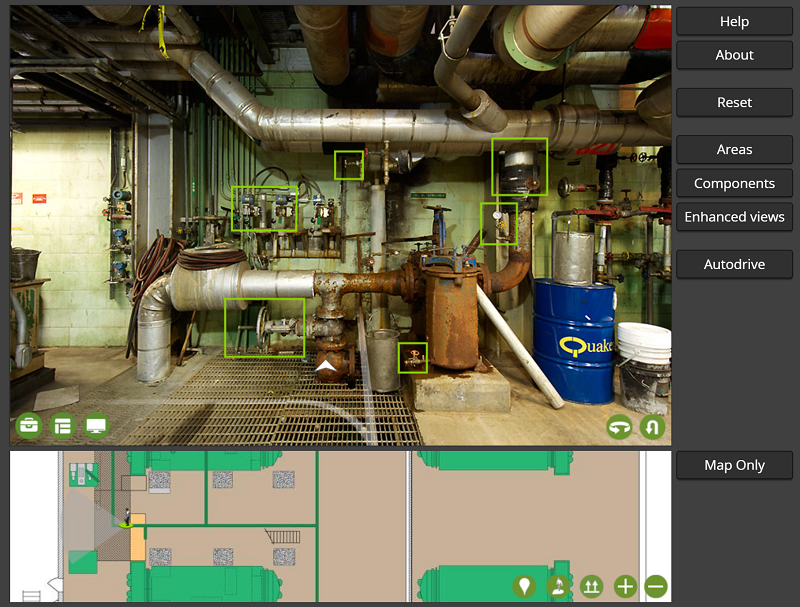
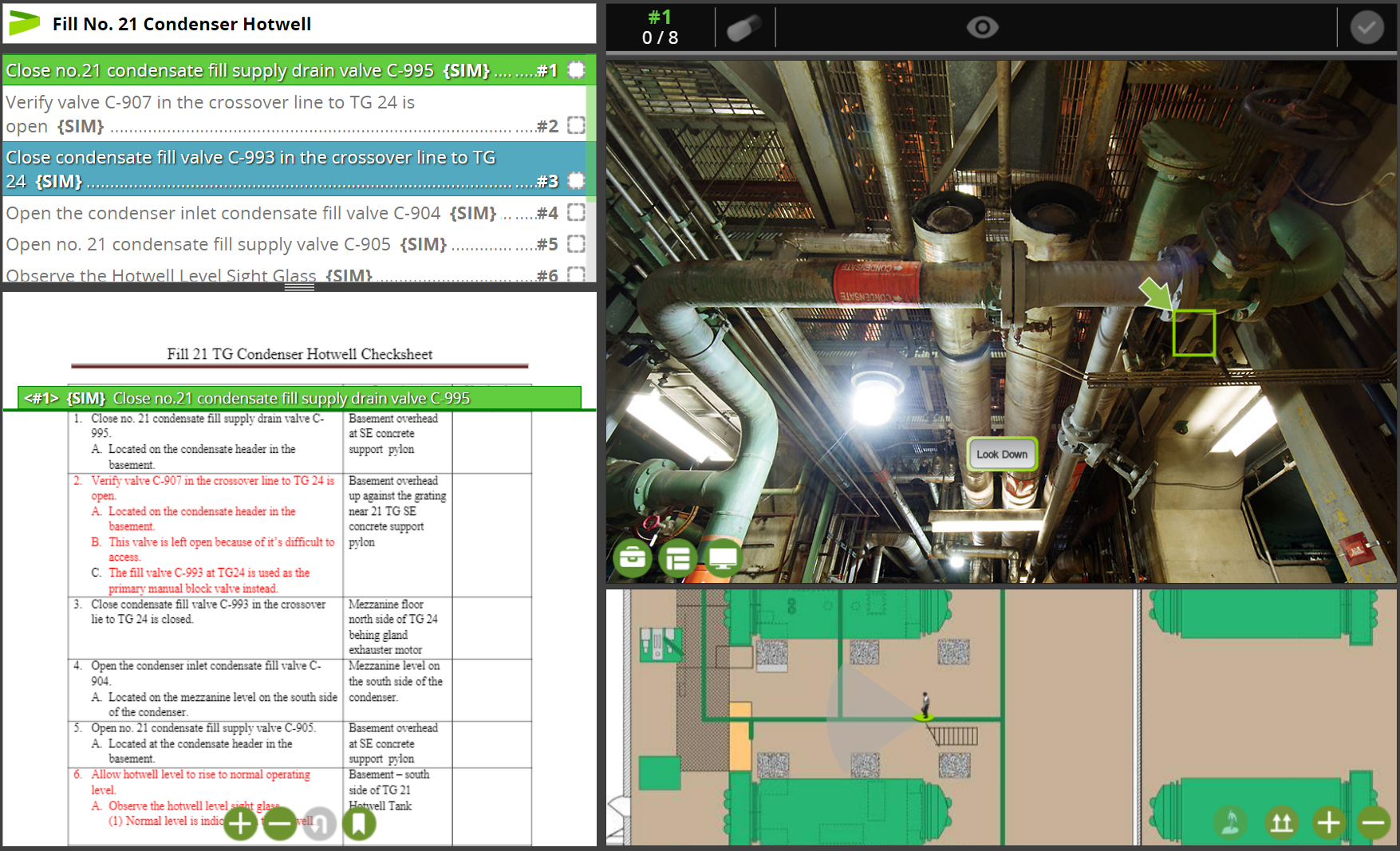
This is where ER technology offers a viable alternative. It enables the creation of digital replicas with unique features using simple photographs (see Figure 1).
In conjunction with the simulation of standard operating procedures, this technology platform is referred to as the Digital Twin of the Person (DToP) by Gartner¹ and offers – amongst others – the following characteristics:
- Patented technology allows the creation of a 3D navigable environment, which is photorealistic.
- The implementation is reasonably easy as it relies on photographic material.
- Thanks to photorealism, the immersive effect greatly enhances the learning experience and is achieved without any specialized equipment. A normal camera and computer is all that is needed.
So, what is the tangible benefit?
How does ER help overcome the workforce challenge?
A case study was carried out in collaboration with a customer in the petrochemical industry, accompanied by Rice University, in order to evaluate the extent to which onboarding of operators can be accelerated by using ER technology.
To this end, 25 new hires with manufacturing experience were divided into two groups. One group was trained on an extruder startup SOP using an ER platform followed by a field walkthrough, while the other group was trained on the same SOP following traditional training methods (classroom, SOPs, P&IDs, field walkthroughs). The next day both groups switched roles and repeated the exercise on a switching catalyst pump SOP.
Table 1 shows the direct comparison of the two training methods. In the ER group, onboarding speed was increased by ~65% while the time that training personnel needed to dedicate to the group was reduced by over 73%. Moreover, the standard deviation of SOP performance among the operator group is significantly reduced and high knowledge retention scores are achieved (not shown)
ER training not only helps overcome the lack of trained personnel as new operators become productive much faster, it also saves SMEs a significant amount of time. Time they can spend on other activities like projects, MOC, process optimization, where their expert contributions are critical and add high value.
| Objectives | Enhanced Reality Training | Traditional Training Methods | Benefit ER vs Traditional Methods |
|---|---|---|---|
| Speed to Competency | 3.3 hrs | 9.75 hrs | 65% faster |
| Dedicated Trainer Oversight | 2.25 hrs | 8.25 hrs | 73% reduction |
| Quality/Standardization of training | All operators in both groups were tested on exact same procedure steps and results were immediately available | ||
Table 1: Enhanced Reality (ER) training vs. traditional training methods
Procedure Clarity
Most SOPs contain ambiguities and imprecise wording. Especially nowadays, not every chemical plant operator has a relevant educational background and time for plant-specific training is scarce, these ambiguities hold the potential for human error.
When implementing ER training, a “line walk” is carried out of each procedure that is simulated. In order to create the script of the SOP simulation, all ambiguities have to be removed. During the line walk, the ER platform’s engineers team up with plant Subject Matter Experts (SMEs) and go through the procedure step by step in the field to fill the gaps.
The result is an action checklist, which is the basis of the training tool and often contains a significantly higher number of steps than the original procedure. As the line walk (photoshoot) progresses, there is an increase in the number of procedural steps. In extreme cases it can be up to a factor of four, but an increase by 50% is typical.
Almost every time, the implementation process comes with an increase in procedure clarity that has a positive impact on reducing human error on its own.
Reduction of Incidents Related to Human Error
As a result of enhanced procedure clarity and better SOP compliance through standardized training and evaluation, a decline in incidents related to human error can be expected. One example is at a large US refinery which had the problem of repetitive environmental releases resulting in reportable incidents and regulatory fines.
The use of the Enhanced Reality Operational Excellence Platform, based on a well-defined and enhanced action checklist, as well as the application of the field execution tool (electronic checklist, part of the Enhanced Reality platform), allowed them to completely eliminate the environmental releases because procedure execution was standardized and practice reflected procedure.
About the Author
Dr. Susanna Voges is Director of Operations at Voovio. She obtained her PhD in Process Engineering at Hamburg University of Technology in 2008. She started her career in the chemical industry at BASF and took over different functions in technical development, working on the design of key equipment for CAPEX projects, troubleshooting at production plants and on process and production optimization. In 2016 she joined manufacturing in pigments production as a plant manager.

References
Check out the the full article in the September issue of Hazardex – The Journal for Hazardous Environments.